A First Garden Walk After the Leaves Fall
A first garden walk after the leaves fall helps you notice winter paths, lasting plant shapes and leaf drifts before deciding what needs attention.
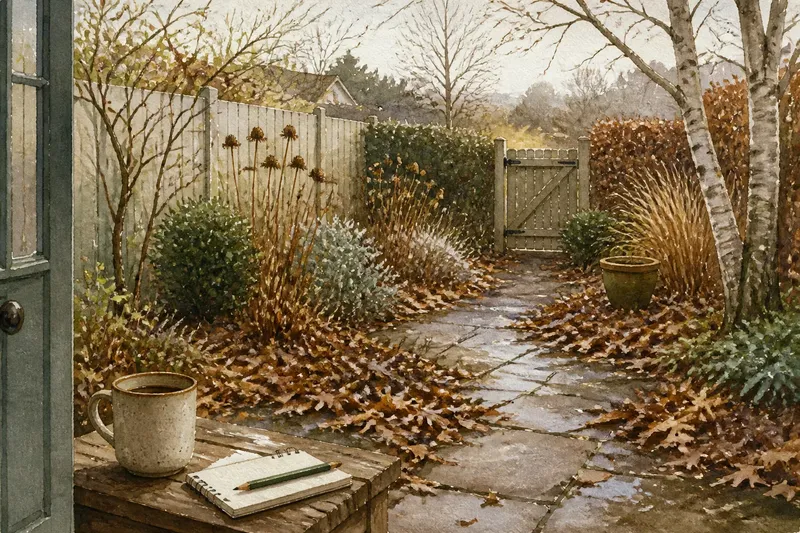
The first garden walk after the leaves fall can begin at the back door, with a mug cooling in your hand and no tools to carry. Without summer foliage filling the view, the route you take, the outlines that remain and the places where leaves collect become easier to notice. The point is not to find work; it is to see the garden in its winter arrangement before deciding whether anything needs to change.
Choose a dry, reasonably bright moment, then walk at an unhurried pace. Keep a small notebook or use a few photographs if you want a record, but leave the rake and secateurs in the shed. These numbered observations offer a way to look closely without turning the visit into a list of jobs.
1. Where does your natural route lead?
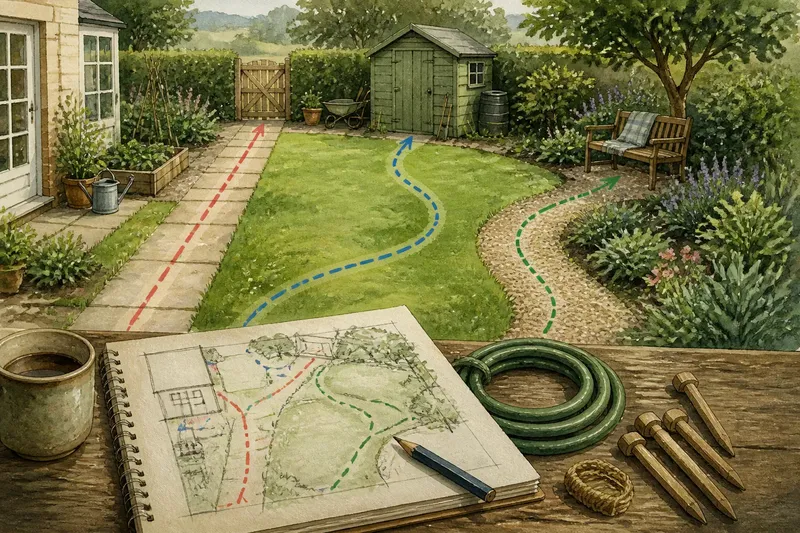
Start at the place you most often enter the garden. Notice which way your feet carry you without prompting: towards the shed, a compost area, the washing line, or a favourite seat. A path on a plan may appear to run elsewhere, but winter makes the routes revealed by use easier to read. Look for a worn strip through grass, a gate that is easiest to reach, or a turn that seems awkward when you are carrying something.
Pay attention to the experience of walking, not just the line of paving. Does a route take you past a sheltered spot, or does it leave you exposed to wind? Is there a pause where you naturally stop to look back at the house or towards a tree? The answers can help explain why a formal path is used often, occasionally or hardly at all.
Don’t decide on a new route during the walk. Just remember where you slowed down, changed direction or stepped around a muddy patch.
2. Which plant shapes still hold the view?
Look across the beds from several places rather than inspecting each plant in isolation. Some forms may remain legible after flowering has ended: a woody framework, a rounded evergreen mass, a fine spray of stems or a broad clump of dried foliage. Others may have flattened or vanished into the background. Notice how these shapes sit against a fence, wall, hedge or the open sky.
This is not a judgement about which plants are good or bad. A bare stem can cast a delicate pattern, while a dense evergreen can make a useful point of contrast. Ask what catches your eye first, what provides a quiet backdrop and where the view seems to lose its shape. Persistent outlines can also reveal whether plants that looked separate in summer now merge into one indistinct patch.
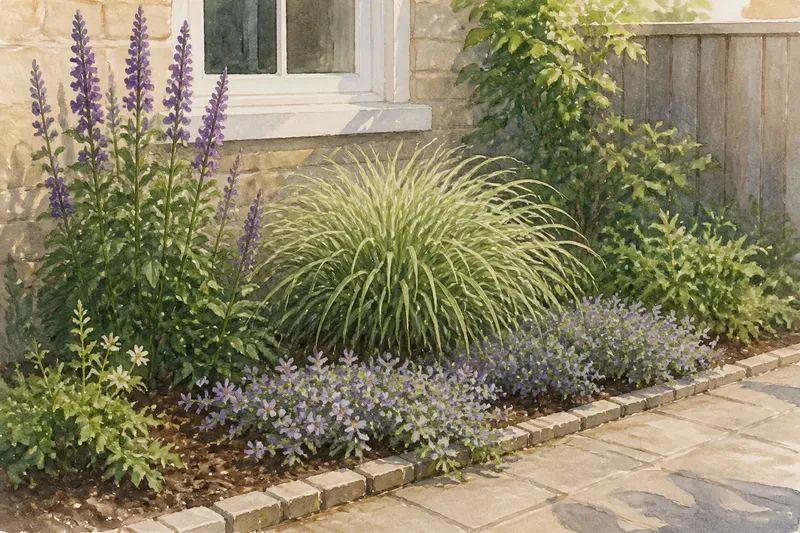
Imagine a narrow bed beside a pale fence, where the summer flowers have faded but a small evergreen shrub and a group of seed heads remain visible. If you note that the seed heads make a clear focal point from the doorway, you can later decide whether to leave them in place, rather than cutting everything down simply because winter has arrived. The observation is about what you see now, not a prescription to retain every stem.
3. Where do fallen leaves settle?
Notice leaves where they have gathered naturally: along a fence, beneath a hedge, against a step, in a shallow hollow or around the base of a pot. A drift can show where the wind loses force or where a garden edge interrupts its movement. Compare the sheltered pockets with open ground, where leaves may be scattered or carried away.
Look at the surface beneath a drift only where it is easy to see. Are the leaves lying loosely over paving, gathered among low plants, or pressed into a wet corner? The same covering can be welcome in one place and inconvenient in another. Leaves caught among fragile stems may bend them, while a dense pile on a frequently used step can make the approach slippery.
Record the location and character of the accumulation before moving it. A few words such as “thin layer under hedge” or “deep drift at gate” are more useful than a vague note that the garden is leafy.
4. What does the winter ground reveal?
Winter makes changes in the ground easier to pick out. Look for patches that remain wet after nearby areas have dried, small channels where water has travelled, and places where bare soil is exposed to passing feet. You are observing how the surface behaves, not diagnosing a drainage problem from one visit. Recent rain, shade and the shape of the ground all affect what you see.
Compare a low spot with a nearby higher one, and notice whether water seems to linger at a threshold or around a container. A path may be comfortable in dry weather but less inviting where its edge stays muddy. If a patch looks different from one day to the next, make a note of the conditions rather than treating a single wet morning as a permanent feature.
For example, say you notice a damp mark beside the gate after rain. Note whether it lies in the walking line or off to the side, and check the same spot on another visit before deciding what it means. That observation may later help you distinguish a recurring inconvenience from a brief effect of the weather.
5. Where can you see from the places you pause?
Stand where you actually spend time: beside the back door, near a seat, or at the point where you turn to go indoors. From each place, take in the view at eye level. A structure that looks balanced from the lawn may disappear behind a fence from the kitchen window; a bare branch may frame a distant roof or catch the last light of the afternoon.
Notice what is in the foreground as well as what lies beyond it. A pot, a low wall or a cluster of stems can either draw the view together or interrupt it. Ask whether there is a particular corner you would like to see from indoors on a grey day, and whether the garden offers a clear line of sight to it.
Make one brief note about each place you pause. “Seat faces the hedge” tells you less than “from the seat, the open gap frames the birch”. Specific observations are easier to use later, but they need not become a design brief before you have finished looking.
6. What changes when you look again?
A single walk is a useful snapshot, not a complete account of winter. Wind can move leaves overnight; rain can darken a path; a low sun can make a modest plant shape suddenly prominent. If you are curious about a feature, return in different weather or from the same spot on another day. Repetition helps separate what is persistent from what is temporary.
Keep the record light. A few notes, a rough sketch or photographs taken from familiar viewpoints can preserve what you noticed without requiring a full garden survey. If you take pictures, try to include a recognisable landmark such as the door, a post or a bench, so you can place the view later. Avoid adding every observation to a running list of chores; the record is there to clarify what you see.
Choose only the observations that seem likely to matter when the garden changes again. A route that feels natural, a plant outline that holds a view, or a leaf drift that blocks a doorway may be worth remembering. The rest can remain simply part of the winter garden.
Questions that arise on a first winter garden walk?
When is the best time to walk the garden?
Choose a moment when you can see the ground and move comfortably, preferably after the weather has settled enough for you to notice the garden rather than fight it. A follow-up in different light or after rain can reveal details that a single visit misses.
Should I take a notebook or my phone?
Use whichever helps you record a clear observation without distracting you from the walk. A notebook suits short notes or a rough sketch; a phone can capture a viewpoint, but add a brief description if the image alone will not explain what caught your attention.
Should fallen leaves be left where they land?
There is no single answer for every spot. Notice whether a drift is smothering low plants, blocking access or making a surface slippery, and distinguish those places from sheltered corners where it causes no evident trouble.
How often should I repeat the walk?
Return when a change in weather or light might help answer a question you have noted. There is no need to follow a fixed schedule; the useful interval is the one that lets you compare the same path, plant outline or leaf drift under different conditions.
Let the observations settle before making changes
At the end of a first garden walk after the leaves fall, choose one view to remember rather than a handful of jobs to complete. Perhaps it is the way a familiar route bends around a wet patch, or the silhouette that remains visible from indoors. A modest record gives you something concrete to revisit when the garden begins to shift again, without asking winter to become a season of constant work.