Upright, Clumping or Spreading: Choosing a Plant Shape
Choosing plant shape helps you place upright, clumping and spreading plants thoughtfully, avoid awkward clashes and give each plant room to suit its role.
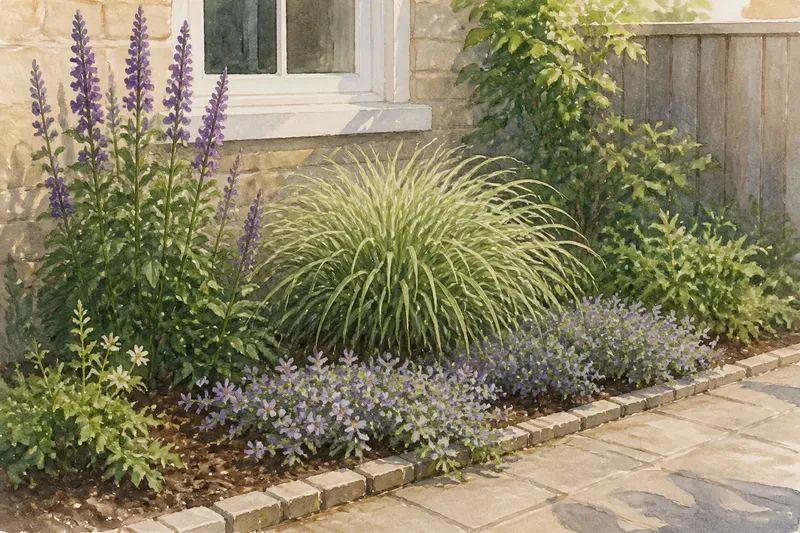
You set a pot beside the front step and notice that its leaves could hide the lower window as they grow. Choosing plant shape before planting helps you see whether an upright, clumping or spreading habit belongs in that space.
These are useful descriptions, not fixed botanical boxes. A plant’s outline can change with age, pruning and growing conditions, so treat the label as a guide to likely growth rather than a promise of an exact shape.
What do upright, clumping and spreading plants look like?
Upright plants grow mainly upwards, often with stems held close together. They can add height without immediately taking up much ground, but some broaden as they mature. Check the stated spread as well as the height.
Clumping plants form a rounded or tufted group from a central crown or base. Many ornamental grasses have this habit, though the label or reliable guidance for the named variety should confirm it.
Spreading plants extend sideways through runners, creeping stems or shoots that root near the parent plant. They can cover open ground or spill over an edge, but may also move into neighbouring plants’ space.
Think of shape as both footprint and direction of growth. A tall plant can still become broad, while a low one may reach well beyond its starting point.
What should you look for on a plant label?
Start with the details that affect placement: mature height and spread, preferred light, and how the plant expands. Labels may use terms such as “upright”, “clump-forming”, “arching”, “creeping” or “vigorous”. These offer clues, but may not explain how quickly the plant reaches its likely footprint.
Check whether the plant is evergreen or dies back seasonally, and whether pruning or division is part of its care. A dormant clump may leave an open patch for part of the year; an evergreen spreader may continue to cover ground. If the label is unclear, ask the supplier or consult reliable guidance for the named variety.
- Check the stated mature height and spread; if either conflicts with the space, choose another position or a more suitable plant.
- Look for words describing how the plant grows; if it spreads by runners and you want a contained mound, select a clump-former instead.
- Check for advice about containment; if the plant may cross a path or enter neighbouring beds, plan an edge or choose a less spreading habit.
- Check the preferred light and soil; if the proposed spot does not suit them, move the plant to a suitable position or choose a better-matched variety.
- Look for seasonal dieback; if a bare patch would be unwelcome, pair the plant with suitable year-round cover or choose an evergreen option.
- Check whether pruning or division is needed to maintain the form; if access would be awkward, place it nearer an edge or choose a lower-maintenance plant.
If the plant’s identity, a label or local rules affect its suitability, check those before buying or planting.
Where does each plant shape work best?
An upright plant can suit a boundary where height is useful but a broad mass would get in the way. Beside a doorway, however, allow for the mature outline so stems do not obstruct the route or cover a window.
A clump can provide a rounded anchor among lower plants. Leave space around its crown for the mound to develop, and consider whether its light and soil needs match those of its neighbours.
A spreader suits an open area where sideways growth has a purpose: perhaps the front of a border or ground beneath taller plants, if conditions suit it. Decide how you will keep it within bounds if it approaches a path, lawn or neighbouring planting.
Imagine a narrow border beside a low window, with a bare patch at the front and a fence behind it. The gardener places a suitable upright plant near the fence, leaves room for a clump in the middle, and puts a contained spreader at the front. The expected result is a layered outline that leaves the window clear and keeps the low plant away from the path; if the spreader’s label indicates it may cross that edge, the gardener substitutes a less spreading plant.
How much space should you leave?
Plan around the likely mature spread rather than the size of the nursery pots. If neighbouring plants are both expected to broaden, consider how their outlines may meet and whether that contact is intentional. Unplanned crowding can hide the forms you chose and make care more difficult.
Not every plant needs to stand alone. A clump may blend naturally into lower planting, for instance. The useful question is whether each plant can keep the shape you want and whether you can reach it when pruning, dividing or clearing dead growth.
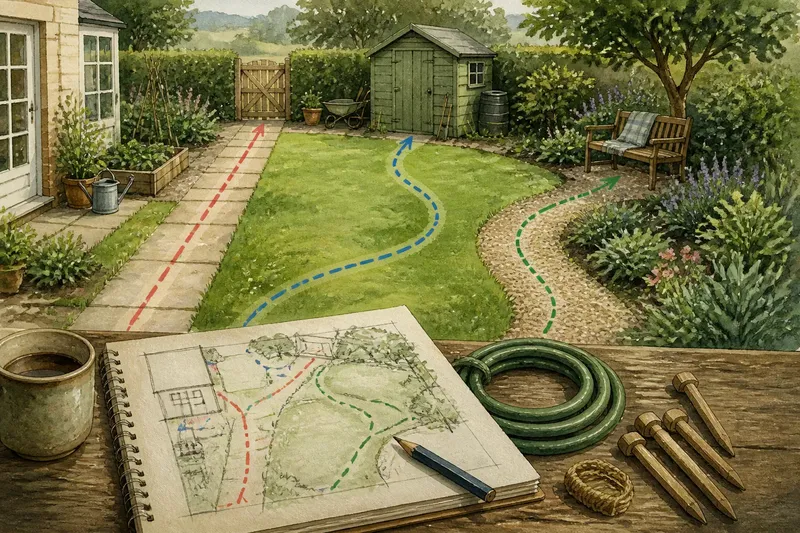
Sketching the bed can make these decisions easier. Mark the edge, nearby structures and likely plant outlines; circles can represent clumps, narrow marks upright forms and broad outlines spreaders. Move pots into the proposed positions while they are still easy to shift, then view the arrangement from a window and the garden approach.
Which plant shape suits a narrow bed or open gap?
Does an upright plant suit a narrow bed?
It may, if its mature spread fits and it will not lean across a route or cover a window. Check the label for outward growth as well as height.
Can a clumping plant fill an open gap?
Yes, when the gap can accommodate its likely mound and its growing conditions are suitable. Leave room for the clump to develop instead of filling every surrounding space with plants that may crowd it.
Where should a spreading plant go?
Choose a place where sideways growth is useful and where you can notice and manage it. A clear edge, such as a path or a defined border line, helps you see when it has reached its intended boundary.
Can different plant shapes grow together?
Yes, if their light, soil and space needs are compatible. An upright plant, a central clump and a low spreader can create distinct layers without asking every plant to fill the same role.
How can you keep the planting balanced?
As plants grow, look at their outlines as well as their flowers. If an upright plant begins to obscure a neighbour, a clump presses against an edge or a spreader crosses its boundary, check the care guidance before deciding whether to prune, divide or move it.
Do not cut every plant back simply to preserve the original sketch. Some forms are meant to arch or merge; others need attention to keep paths and neighbouring crowns clear. Use clean, suitable tools for routine pruning, and seek advice if you are unsure how a particular plant should be handled.
Choosing plant shape is easier when you plan for growing outlines rather than pot-sized objects. Check the named variety’s likely form and growing needs, then position it where that shape has room to work.