Why a Garden Path Changes How a Space Gets Used
See how garden path position and destination shape everyday movement, then sketch likely routes before choosing a line that suits your space.
You step out with a mug, mean to reach the bench, and find yourself cutting across the lawn instead of taking the neat path beside it. A garden path changes how a space gets used only when its position and destination match the movements people already want to make.
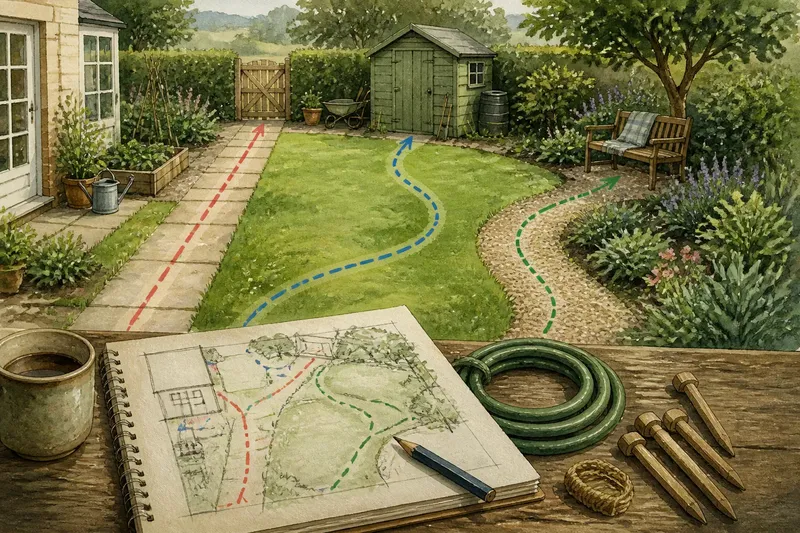
Before choosing paving, gravel or a curve, sketch the routes that connect the house, gate, shed, seating and places you tend. The drawing need not be polished: its job is to reveal which journeys deserve a direct line and which parts of the garden should remain open.
What should a path connect?
Begin with destinations rather than a shape. Mark the doors and gates people actually use, then add places they visit regularly: a bin store, washing line, greenhouse, favourite chair or a patch that needs frequent attention. A path to an ornamental feature can be useful, but it should not displace a route that serves a routine task.
Distinguish between a destination and a view. A tree may draw the eye without needing a paved route to its trunk; a narrow gap beside the house may be visited often despite having little visual presence. This distinction helps prevent a garden from acquiring paths that lead nowhere in daily life.
For each connection, note who makes the journey and what they carry. Someone taking tools to a shed moves differently from a person strolling to a seat. The route for a wheelbarrow, watering can or laundry basket may need fewer awkward turns than a path intended chiefly for a slow wander.
Should a path be direct, curved or branched?
When does a direct path make sense?
A direct route suits frequent journeys between important places, especially where people already cross the same strip of lawn. It makes the destination plain and avoids unnecessary detours, though a straight line can divide a small garden if it cuts through its most useful open area.
What does a curved path offer?
A curve can slow the sense of movement and reveal a space gradually. It suits a route meant for lingering or a garden where a straight cut would expose a view better kept partly screened, but the curve should still connect places rather than wander without purpose.
When is a branch worth adding?
A branch is useful when one main route serves several distinct destinations, such as a sitting area and a side gate. It suits gardens with regular trips in different directions; too many forks, however, can make the layout harder to read and divide planting into narrow scraps.
Choose the simplest route that serves the journeys you have marked. Add a bend or branch only when it has a clear job.
How can you sketch likely routes before fixing the shape?
Use a rough plan, a notebook and a few observations from ordinary days. You do not need to calculate every movement; look for repeated choices and places where people hesitate, detour or cross a planted area.
- Draw the garden boundary and mark doors, gates and fixed features such as the house, large trees and shed.
- Add useful destinations, including seating, growing areas, taps and storage, even if some are temporary.
- On separate copies, sketch the route for each common journey with a pencil. Keep routes distinct before deciding whether they can share a path.
- Walk the proposed lines on the ground, using string or a garden hose to suggest their edges. Walk them as you would with a basket or wheelbarrow, not only as an observer.
- Notice where the line feels cramped, where it crosses a place you want to keep open, and whether the destination is easy to approach.
- Revise the sketch, then mark the preferred line with pegs before choosing its material or final width.
Say you have a side gate, a shed and a bench, with a worn shortcut between the gate and shed. In an invented planning situation, you might sketch a direct shared route to the shed and a gentler spur to the bench; walking those lines could show that the spur leaves the centre of the lawn clear while the shortcut becomes an obvious, practical connection.
Which route suits your garden?
A compact, task-led layout often suits a direct path. Choose it when the same destinations serve daily routines and a straight line does not split the most useful part of the garden. A simple route is also easier to understand at a glance.
A leisurely layout may suit a curved route. Choose it when the journey itself is part of the experience, when a view should unfold gradually, or when the available space naturally bends around planting. Keep the destination legible so the curve feels intentional rather than inconvenient.
A garden with several active destinations may suit a main route with one or two branches. Choose this when trips to separate places are frequent enough to justify distinct connections. If a destination is occasional, a simple stepping route or an unpaved approach may be preferable to another permanent line.
When routes compete, give priority to the one that needs to work reliably in ordinary use. A handsome path that people avoid because it misses the gate or makes carrying tools awkward is not serving its purpose.
What should you check before settling on the line?
Look at the proposed path from the house and from its destinations. Does it invite a natural approach, or does it end short of where someone needs to stand? Check whether it passes close enough to a seat, shed door or growing area to be useful without pinching access.
Consider what the route will leave behind. A path can divide a lawn into awkward shapes, interrupt a broad planting bed or create a shortcut across a quiet corner. Sometimes a small shift in position preserves the same connection while giving the surrounding space a more coherent use.
Also decide whether the route needs to be permanent. A well-used journey may deserve a settled surface; a route you are still assessing can remain lightly marked while habits become clearer. Where the choice of surface or construction depends on product instructions or local requirements, follow those directions and rules.
How do you know the sketch is ready?
The garden path should make common journeys feel natural, reach its destinations clearly and leave the rest of the space with a purpose. Walk the marked line once more at the pace of an actual errand, then pause at each end and ask whether you would choose it without being told to.
If the answer is uncertain, move the string or hose and try again before committing to a shape. A short adjustment on paper can preserve a useful open area, and the best garden path position is the one that makes the garden easier to inhabit rather than merely easier to cross.